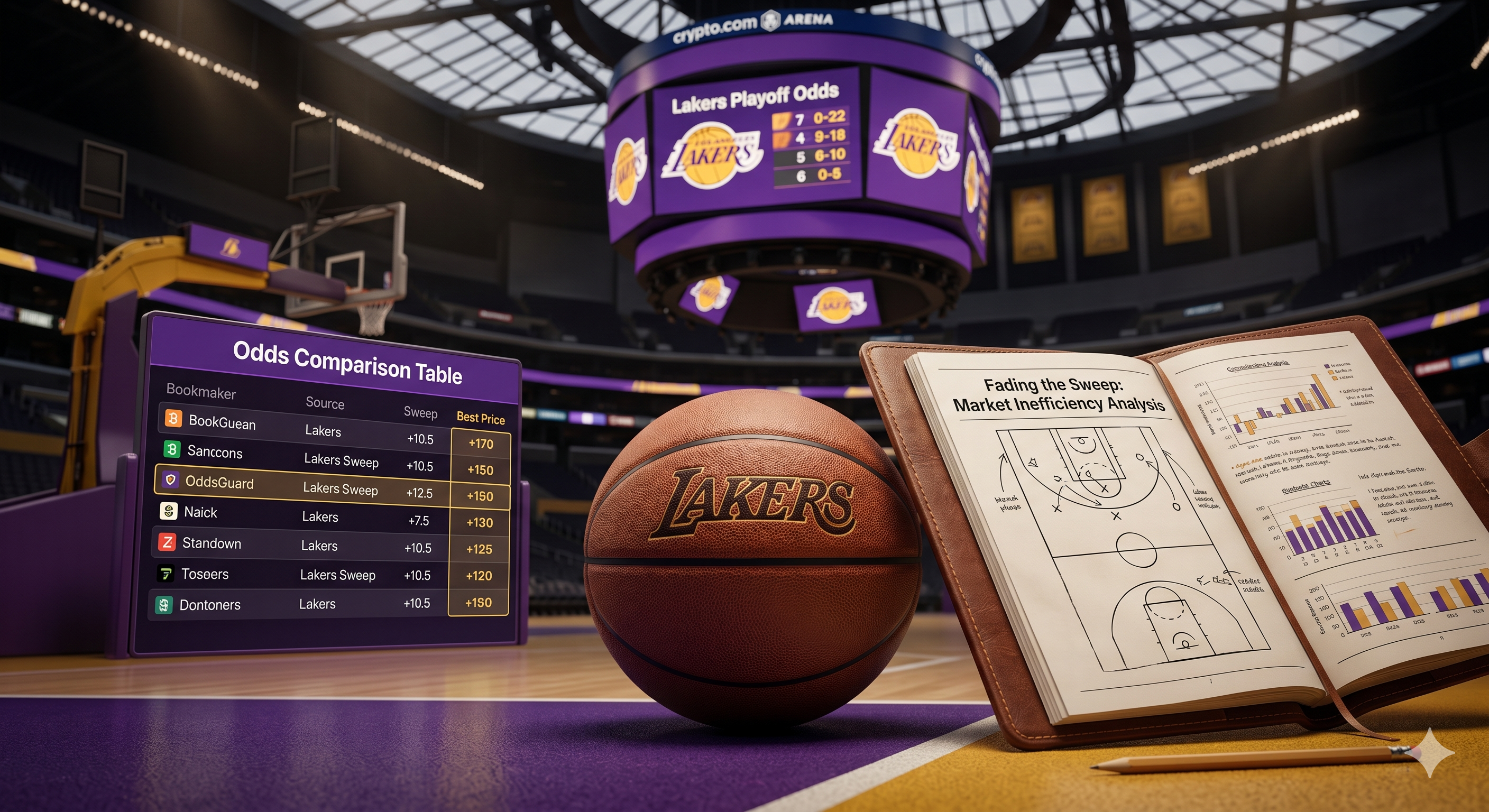
In the high-stakes world of NBA playoff betting, few phrases carry more emotional weight than "The Lakers are getting swept." Whether it’s Stephen A. Smith shouting it from the First Take desk or a "sharp" thread on X dissecting LeBron’s mileage, the narrative of a Los Angeles collapse is a perennial favorite.
But here is the hard truth of professional gambling: The "sweep" narrative is a trap if you aren’t shopping the price.
The 2026 postseason has already provided a masterclass in market inefficiency. When the Lakers entered the first round against Houston as massive +550 underdogs—shorthanded without Luka Dončić and Austin Reaves—the public consensus was a funeral march. Yet, L.A. shocked the world by taking a 2-0 lead, proving that even a "banged-up" roster can punish a market that over-indexes on narrative and under-values variance.
The Math of the "Sweep"
From an analytics perspective, betting on a sweep (a 4-0 series result) is often a high-variance play that requires precision. If a sportsbook is offering -110 on a Thunder sweep over the Lakers in the second round, they are implying a roughly 52% probability.
However, sharp bettors look at the opening vs. closing lines. If the market opens at -110 but closes at -150 due to public "Lakers hate" money, the value has evaporated. At that point, even if the sweep happens, you made a "bad" bet. You paid a premium for a consensus opinion.
Long-term profitability isn't about being "right" about who wins; it's about being right about the probability and getting the best possible number to back it up.
Market Inefficiencies: Opening vs. Closing Lines
We saw this in action during the Lakers/Thunder series. After a blowout Game 1 loss where L.A. tumbled 108-90, the "sweep" talk reached a fever pitch. This creates market noise. While casual bettors are chasing the Thunder spread in Game 2, the smart money is looking for the discrepancy.
Is one book still hanging a +6.5 while the rest of the market has moved to +5.5? That single point is the difference between a winning ticket and a "push" or a loss. In a league as talent-heavy as the 2026 NBA, those margins are where the "edge" lives.
Real-Time Line Movements and the Safari Edge
The friction of the modern bettor is real. Between FanDuel, DraftKings, BetMGM, and P2P platforms, a line can move in seconds while you are switching apps. If you see a massive line discrepancy—say, a Lakers Moneyline that is significantly higher on one book because of a localized liability—you have to act instantly.
This is where technology bridges the gap. By using the OddsGuard Safari Extension, you aren't just guessing where the value is. You are seeing real-time comparisons directly in your browser. It removes the "friction" of the 10-app shuffle and ensures that when you decide to fade the "Lakers sweep" narrative—or join it—you are doing so at the best price on the planet.