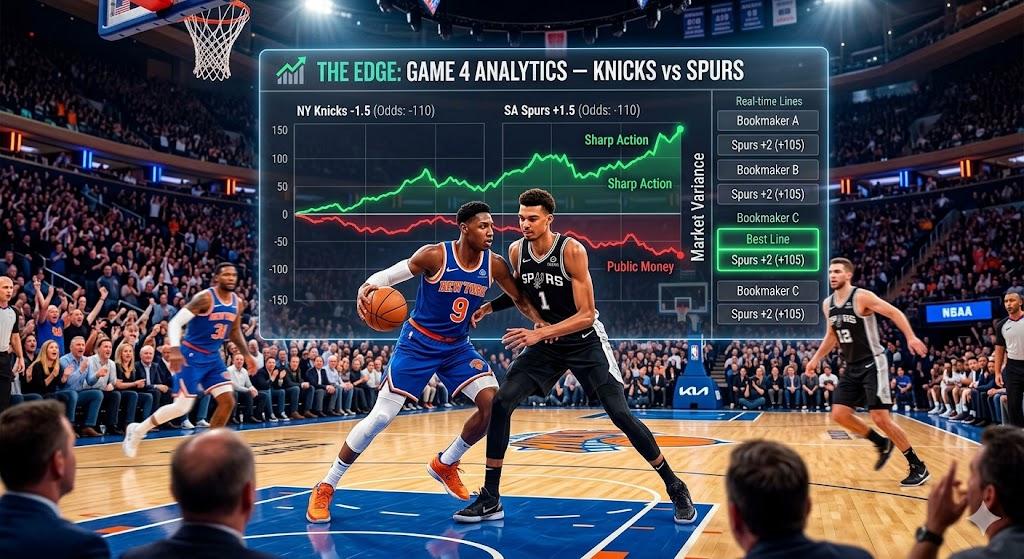
The 2026 NBA Finals have delivered pure chaos. After the New York Knicks ran off an astonishing postseason win streak, Victor Wembanyama and the San Antonio Spurs forcefully responded in Game 3 with a thrilling 115-111 victory at Madison Square Garden.
Now, with New York holding a tight 2-1 series lead, Game 4 is shaping up to be an absolute dogfight. The market reflects it: the opening consensus line tabs the Knicks as a fragile 1.5-point home favorite, with the point total hovering at 216.5.
But here is the foundational truth that separate casual sports fans from profitable bettors: even a great pick is a bad bet at the wrong price.
When lines are this razor-thin, the difference between cash and a bad beat isn't your sports knowledge. It's your execution. In a series dominated by heavy public volume and immediate sharp reactions, relying on a single sportsbook app means you are willingly giving away your mathematical edge.
The Game 4 Anatomy: Opening vs. Closing Lines
Market inefficiencies are on full display during the NBA Finals. When millions of public dollars flood the market, oddsmakers shift lines not based on predicted outcomes, but to balance their financial liability. This creates massive variance across the betting ecosystem.
Take a look at how early line-shopping and real-time line movements completely rewrite a bettor's risk profile:
| Bet Type | Sportsbook A | Sportsbook B | OddsGuard Best Price Edge |
| Knicks Moneyline | -130 | -122 | Saves $8 per $100 payout |
| Spurs Spread | +1.5 (-110) | +2 (-115) | Extra 0.5 point protection |
| Game Total (Over) | 217.5 (-110) | 216.5 (-110) | Full point discount on the Over |
If you like the Knicks to bounce back at home, laying -130 at a generic book when a competitor is sitting at -122 is fundamentally burning money. Over a full season, failing to secure that 8-cent difference destroys your lifetime value (LTV) as a bettor. Real edge isn’t finding a lock; it’s consistently grabbing the mispriced number before the market corrects to the closing line.
Stop App-Hopping: The Friction is Costing You Money
The typical sports fan handles a massive sports event like Game 4 by opening up three or four different mobile apps, rotating through security logins, trying to memorize numbers, and missing the optimal entry point as the odds shift. By the time they lock in a bet, the value has already evaporated.
Worse yet, if you are analyzing California-specific P2P spaces or alternative models, tracking compliance variations manually is a logistical nightmare.
Long-term profitability relies on automation. You need to instantly recognize when a major book is lagging behind a market-wide shift, giving you an artificial window of opportunity to strike a mispriced line.